Many manufacturing companies invest crores in machinery, certifications, infrastructure, manpower, and production capabilities. Yet they face one common challenge: sales are inconsistent.
The factory is capable. The quality is proven. The production team is experienced. But enquiries are unpredictable. Some months generate multiple RFQs while other months remain completely silent.
Most manufacturers believe the problem is competition, pricing, or market conditions. In reality, the problem is often visibility.
Modern buyers no longer depend solely on exhibitions, dealer references, or personal networks. Today, procurement managers, OEM buyers, sourcing teams, distributors, and international buyers begin their supplier search online. If your company is not visible during that search, you lose opportunities before your sales team even gets a chance to compete.
Twenty years ago, manufacturers generated business through trade exhibitions, distributor networks, personal references, cold calling, and industry associations. Today, buyers follow a different process.
Buyers now search Google, compare manufacturers, review certifications, evaluate production capabilities, shortlist suppliers, and then send RFQs. If your company does not appear during the first four steps, you never reach step six.
This is where manufacturing digital transformation becomes critical. Manufacturers that invest in a strong digital presence are more likely to attract qualified buyers, generate RFQs, and build a predictable sales pipeline.
Manufacturing companies have traditionally relied on exhibitions, dealer networks, referrals, and direct sales teams. While these channels remain valuable, today's buyers begin their supplier evaluation online.
Manufacturing digital marketing promotes industrial products, manufacturing capabilities, and business expertise through digital channels to attract OEMs, distributors, procurement teams, consultants, and export buyers.
The objective is not simply to increase website traffic. The objective is to generate qualified business opportunities and support long-term sales growth.
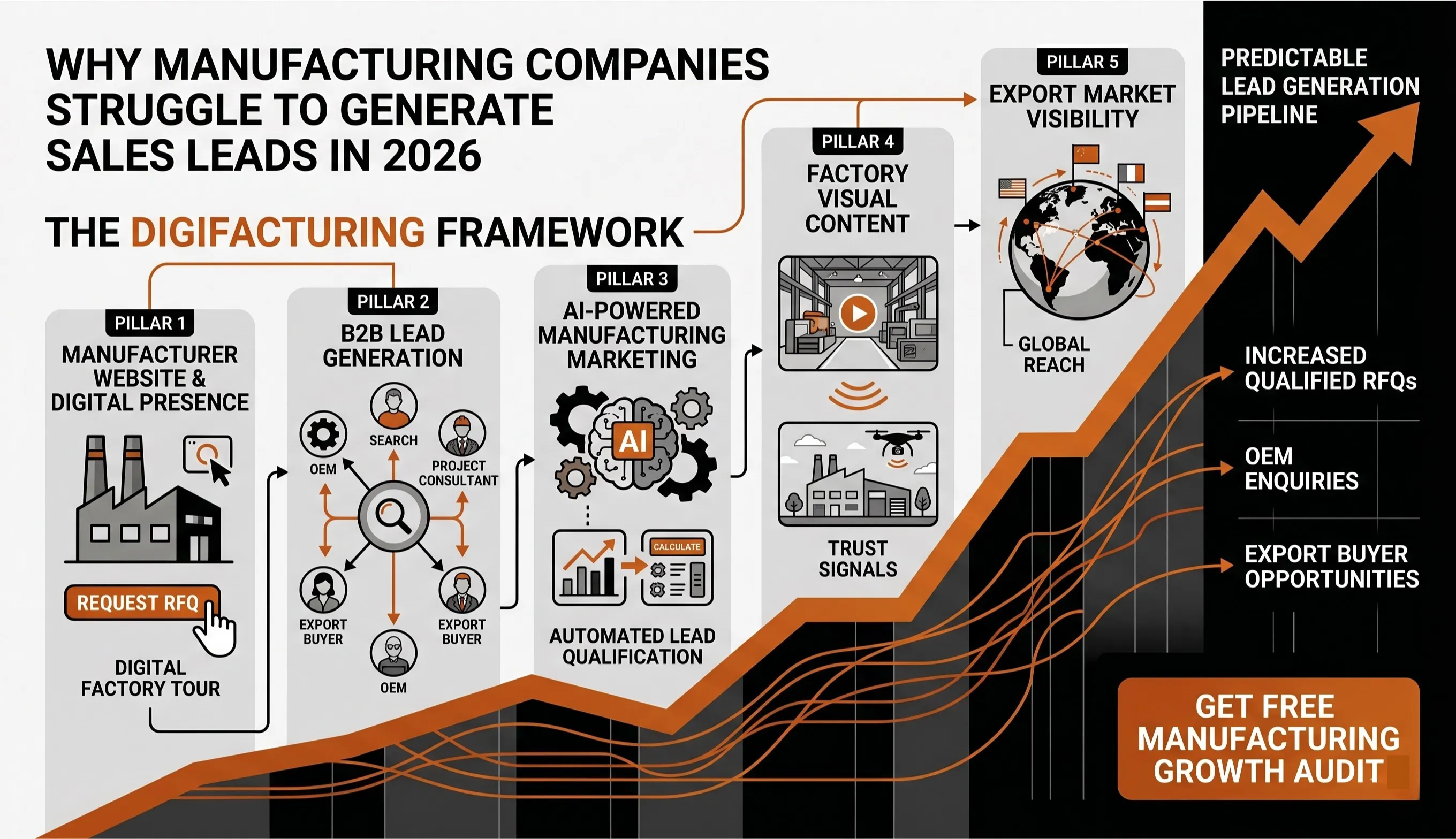
Your website becomes your factory's digital front door. It should showcase your products, manufacturing capabilities, certifications, industries served, and convert visitors into enquiries.
Industrial buying cycles typically last between 3 and 12 months. Effective lead generation combines SEO, LinkedIn outreach, Google Ads, retargeting, and lead nurturing to generate qualified RFQs.
AI helps manufacturers scale visibility through technical content creation, lead qualification, campaign optimisation, and personalised buyer engagement while reducing marketing effort.
Professional factory photography, drone videos, production walkthroughs, and machinery showcases help build buyer confidence and demonstrate manufacturing capability.
Export-ready digital assets, international SEO, and export-focused product pages help overseas procurement teams discover, evaluate, and contact your manufacturing business.
Generate enquiries from buyers actively searching for your products and manufacturing capabilities, resulting in better conversion rates.
Build a diversified customer base through continuous digital lead generation instead of relying on a few existing customers.
Create a consistent flow of enquiries every month, improving sales planning, production forecasting, and business growth.
Manufacturing companies no longer compete only on quality, pricing, or production capacity. They compete on visibility. The manufacturers that are easiest to find, easiest to trust, and easiest to evaluate online consistently win more RFQs, OEM contracts, distributor partnerships, and export opportunities.
Digifacturing is a manufacturing-focused digital transformation framework that combines industrial websites, lead generation systems, AI-powered marketing, visual credibility assets, and export market visibility.
Manufacturers generate more RFQs by improving search visibility, creating technical content, showcasing manufacturing capabilities, and implementing structured lead generation systems.
Most manufacturing websites function like brochures instead of buyer-focused sales tools. They fail to communicate technical expertise, credibility, and manufacturing capability.
Yes. Digital visibility helps small and medium manufacturers compete with larger companies for OEM contracts and industrial projects.
Most manufacturers begin seeing measurable improvements within 3 to 6 months, while stronger lead generation typically takes 6 to 12 months.
Focus on RFQs, qualified enquiries, OEM opportunities, export enquiries, cost per lead, conversion rates, and revenue generated through digital channels.
Many export buyers evaluate suppliers online before making contact. Manufacturers with poor digital visibility frequently lose opportunities to competitors with stronger online presence.
AI helps manufacturers automate content creation, lead qualification, campaign optimisation, and buyer personalisation while maintaining consistent marketing output.
Begin with a Digifacturing audit to identify visibility gaps, credibility issues, and missed opportunities before implementing a digital growth strategy.
