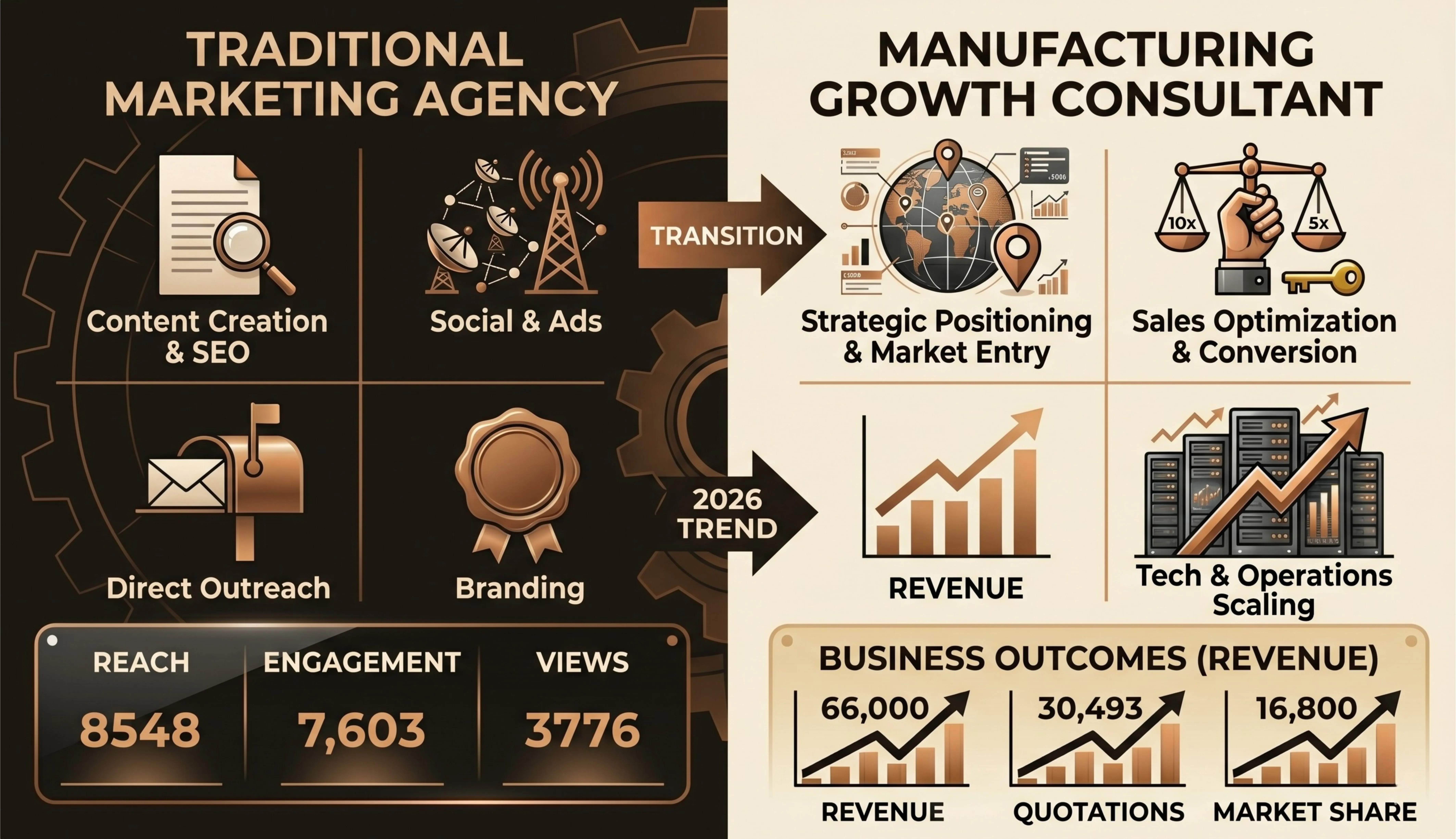
The manufacturing sector is changing how it approaches business growth. For years, manufacturers relied on marketing agencies to build websites, manage social media, run advertising campaigns, and improve brand awareness.
While these services remain valuable, many manufacturers are realizing that marketing activities alone do not always generate business growth.
A modern website does not automatically produce qualified enquiries. More website traffic does not guarantee new customers. Social media engagement does not necessarily result in OEM partnerships or export opportunities.
Manufacturers are now asking a different question:
Do we need a marketing agency, or do we need a manufacturing consultant who understands business growth?
This shift is increasing demand for manufacturing consultants who focus on measurable business outcomes instead of marketing deliverables.
Marketing agencies commonly provide services such as:
These services improve visibility, but they rarely solve broader business challenges.
Manufacturers often need answers to strategic questions such as:
These questions require business strategy, market intelligence, and manufacturing expertise—not just marketing execution.
Marketing agencies focus on promotional activities and campaign execution.
Success is typically measured through impressions, clicks, followers, and website traffic.
A manufacturing consultant focuses on business performance and sustainable growth.
Success is measured through qualified enquiries, customer acquisition, revenue, and market expansion.
A Manufacturing Growth Consultant combines strategy and execution into one structured growth framework.
The goal is to help manufacturers identify growth opportunities and improve long-term business performance.
An Industrial Business Consultant focuses on improving overall business competitiveness.
A Manufacturing Strategy Consultant aligns every part of the business with long-term growth objectives.
This creates a roadmap for sustainable business growth.
Review the company's current business performance and identify the real causes of slow growth.
Connect business strategy with marketing and sales activities.
Implement systems that support long-term business growth.
Manufacturing consulting is valuable across many industrial sectors, including:
As AI-powered search platforms continue to influence supplier discovery, manufacturers also need stronger digital authority through structured content, topic expertise, and AI visibility strategies.
Marketing agencies help manufacturers become visible. Manufacturing consultants help manufacturers become more competitive, profitable, and scalable.
A marketing agency focuses on marketing execution such as SEO, advertising, websites, and social media. A manufacturing consultant focuses on business strategy, market positioning, lead quality, revenue growth, and long-term business performance.
Manufacturers increasingly want strategic business guidance and measurable commercial outcomes rather than marketing activities alone.
A Manufacturing Growth Consultant helps manufacturers improve lead generation, expand into new markets, strengthen sales processes, improve digital visibility, and build sustainable business growth.
An Industrial Business Consultant identifies growth opportunities, improves competitive positioning, optimizes customer acquisition, and strengthens overall business performance.
A consultant is most valuable when business growth has slowed, lead quality is poor, market expansion is planned, sales cycles are becoming longer, or digital transformation initiatives are not producing expected results.
AI is changing how industrial buyers discover suppliers. Manufacturing consultants help businesses improve visibility across AI platforms by developing structured content, topic authority, and AI-friendly digital ecosystems.
Not necessarily. Consultants provide strategic direction while agencies execute marketing activities. Manufacturers often achieve the best results when both work together under a clear business growth strategy.
Electrical manufacturers, engineering companies, OEM suppliers, packaging manufacturers, textile exporters, EV component manufacturers, industrial automation firms, and contract manufacturers often benefit the most from manufacturing consulting.
