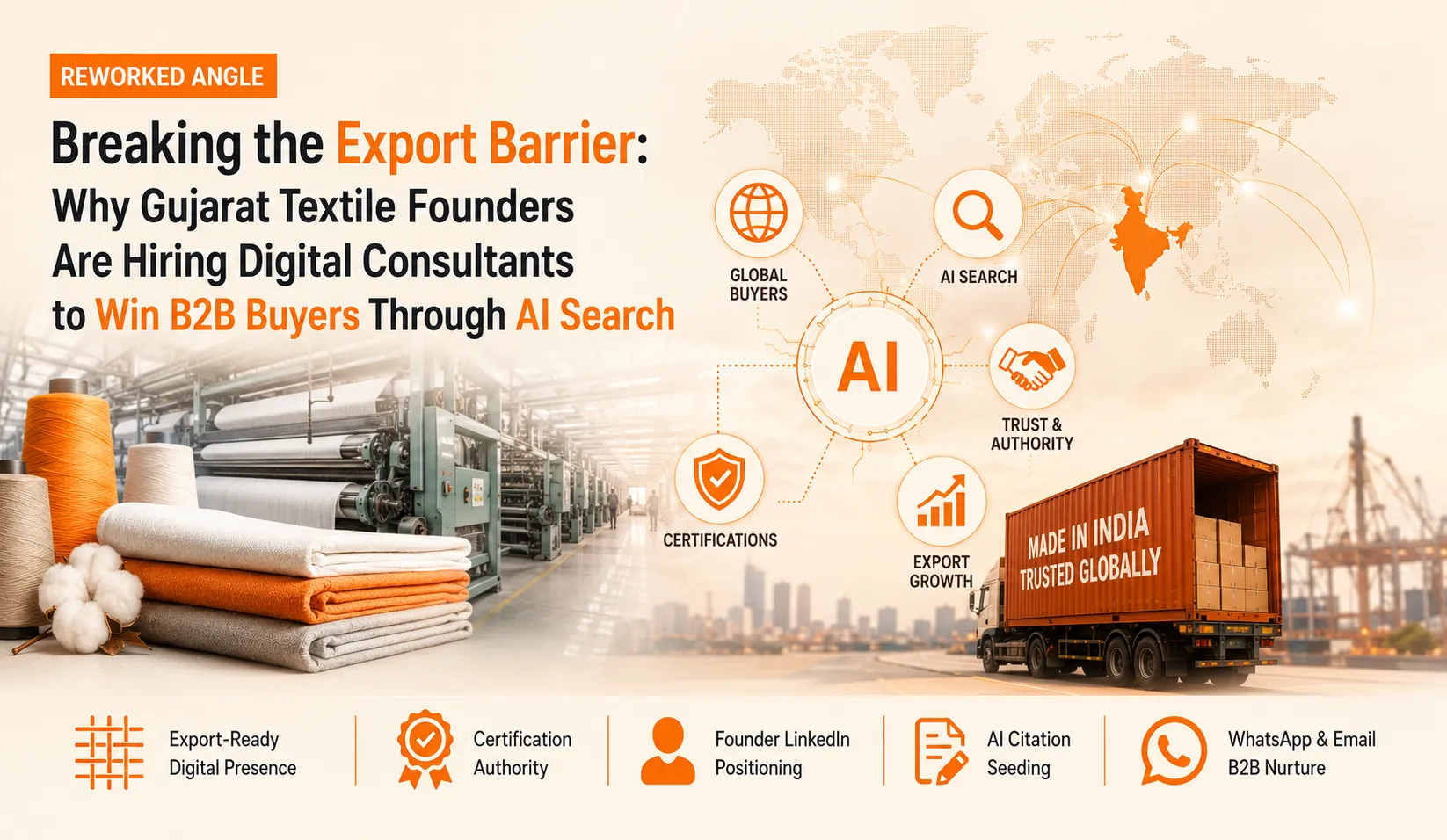
The traditional textile export pipeline built around trade fairs, IndiaMART listings, buying agents, and long-term relationships is changing.
International procurement managers are increasingly using AI platforms such as ChatGPT, Perplexity, and Google AI Overviews to discover and shortlist textile suppliers before contacting them.
Typical AI searches include:
Manufacturers that appear in AI-generated answers gain visibility early in the buying journey, while others may never reach the buyer's shortlist.
For decades, Gujarat's textile manufacturers relied on overseas buying agents, repeat customers, trade fairs, and industry networks to grow exports.
Today, international buyers use AI to evaluate suppliers before speaking with an agent or attending an exhibition.
Digital authority is becoming just as important as long-standing business relationships.
Create a website designed for international buyers with detailed product specifications and technical information.
Content should be structured so both buyers and AI platforms can easily understand it.
Showcase every quality and sustainability certification throughout the website using structured content.
Certification visibility increases buyer confidence and strengthens AI recognition.
Build the founder's professional presence by regularly sharing expertise about manufacturing capabilities, sustainability initiatives, production capacity, and innovation.
A strong LinkedIn profile supports credibility with both buyers and AI search platforms.
Increase digital authority by earning mentions across trusted textile and export industry platforms.
These citations help AI engines validate your company's expertise.
International textile sales often take several months from first enquiry to purchase order.
Structured email and WhatsApp follow-up campaigns keep your company visible throughout the buyer's evaluation process.
International buyers increasingly rely on AI-generated recommendations rather than traditional search results.
Manufacturers with strong digital authority, structured product information, certification visibility, and trusted industry citations are more likely to be recommended by AI platforms.
Digifacturing helps manufacturers improve visibility across Google AI Overviews, ChatGPT, Perplexity AI, Gemini, and Microsoft Copilot by building structured digital authority and trusted citation signals.
The audit reviews your website, LinkedIn presence, Google visibility, AI visibility, competitor positioning, and provides a prioritized roadmap for improving digital authority over the next 90 days.
Most projects begin with a Discover phase lasting 2–4 weeks, followed by a Build phase of 6–10 weeks. Scaling activities continue over several months, with qualified leads often appearing within 90 days and stronger AI visibility developing over 6–12 months.
Yes. The consulting framework supports manufacturers across India through remote strategy, digital transformation, AI marketing, and export-focused lead generation.
Digifacturing works with manufacturers in industrial equipment, electrical components, packaging, food processing, FMCG, auto-ancillary, engineering, textiles, garments, electronics, PCB manufacturing, and emerging green energy sectors.
