For many manufacturers, IndiaMART has become the primary source of business enquiries. It provides visibility, connects buyers with suppliers, and delivers a continuous flow of leads.
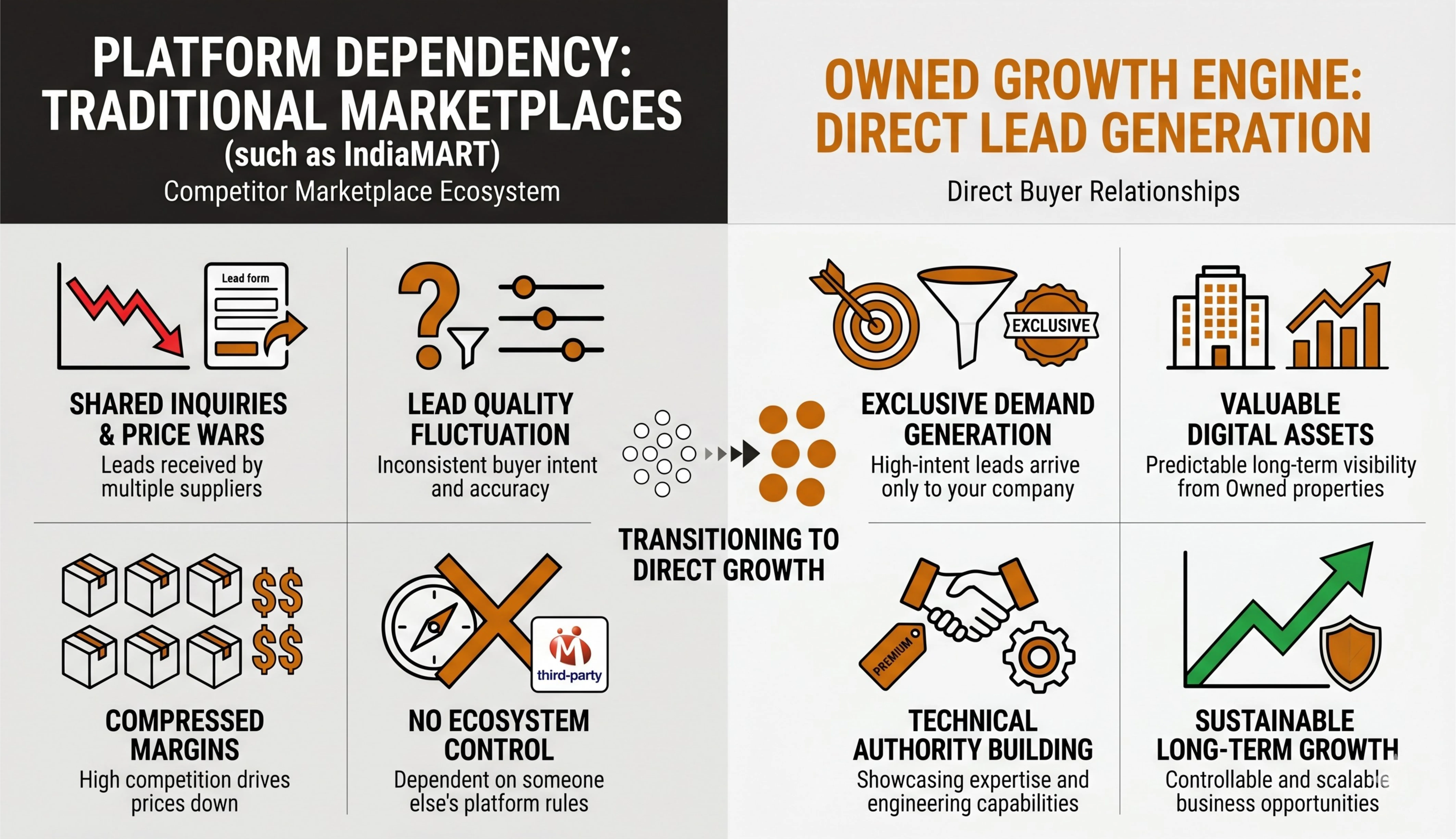
However, relying entirely on a third-party marketplace creates long-term business risks. Lead quality changes, competition increases, pricing evolves, and multiple suppliers often receive the same enquiry.
Manufacturers do not control the audience, search rankings, customer data, or enquiry distribution on marketplace platforms. This creates dependency instead of sustainable growth.
Leading manufacturers are now investing in their own lead generation systems to gain greater control over customer acquisition and long-term business growth.
Direct lead generation means attracting buyers through digital channels owned and managed by the manufacturer.
These channels include:
Unlike marketplace enquiries, direct leads often come from buyers who have researched the company, explored its capabilities, and developed trust before making contact.
Industrial buyers actively search for manufacturers using Google and other search engines.
Industrial SEO improves visibility for searches such as:
Strong SEO delivers qualified traffic, better enquiries, and lower customer acquisition costs.
Procurement teams increasingly use AI platforms to identify suppliers and compare manufacturers.
Building structured, authoritative content improves visibility across:
AI visibility helps manufacturers become part of supplier recommendations during buyer research.
Educational content builds trust before sales conversations begin.
Effective content includes:
Content marketing helps shorten the sales cycle by answering buyer questions early.
LinkedIn allows manufacturers to connect directly with decision-makers.
Unlike marketplaces, LinkedIn helps manufacturers build long-term business relationships.
A manufacturing website should do more than generate traffic.
High-converting websites include:
The objective is to convert visitors into qualified business enquiries.
Build strong SEO foundations and improve AI discoverability so buyers can easily find your business while researching suppliers.
Publish technical content, industry resources, and case studies that build trust and establish your company as a preferred manufacturing partner.
Implement lead capture systems, LinkedIn outreach, CRM integration, and lead nurturing processes that transform visibility into qualified enquiries.
Direct lead generation is highly effective for manufacturers in sectors such as:
These businesses benefit from stronger digital visibility, AI discoverability, customer relationships, and predictable lead generation.
IndiaMART remains a valuable source of enquiries, but it should be one component of a broader lead generation strategy rather than the only source of new business.
Beyond IndiaMART refers to creating independent lead generation systems that help manufacturers generate direct enquiries through their own digital assets instead of relying solely on third-party marketplaces.
Manufacturers can generate qualified leads through Industrial SEO, AI search optimization, LinkedIn marketing, content marketing, industry-specific landing pages, email marketing, and website conversion optimization.
Direct lead generation involves attracting buyers through owned channels such as websites, search engines, AI platforms, LinkedIn, email campaigns, and educational content.
Successful strategies include Industrial SEO, AI visibility, content marketing, LinkedIn outreach, website optimization, and authority-building content that attracts high-intent buyers.
Direct enquiries usually come from buyers who have already researched the manufacturer, explored technical content, and built trust before making contact, resulting in higher purchase intent.
B2B manufacturing lead generation focuses on procurement teams, engineers, OEM buyers, and long sales cycles. It requires educational content, technical information, and relationship building rather than impulse purchases.
AI visibility increases the chances of appearing in supplier recommendations on platforms like ChatGPT, Gemini, Claude, and Perplexity, helping manufacturers reach buyers during research and evaluation.
Digifacturing combines manufacturing digital transformation, SEO, AI visibility, content marketing, LinkedIn outreach, and lead generation into a unified growth framework that produces higher-quality business enquiries.
Electrical manufacturers, packaging companies, engineering firms, OEM suppliers, textile exporters, EV component manufacturers, industrial automation businesses, and contract manufacturers can all benefit from building their own lead generation engine.
